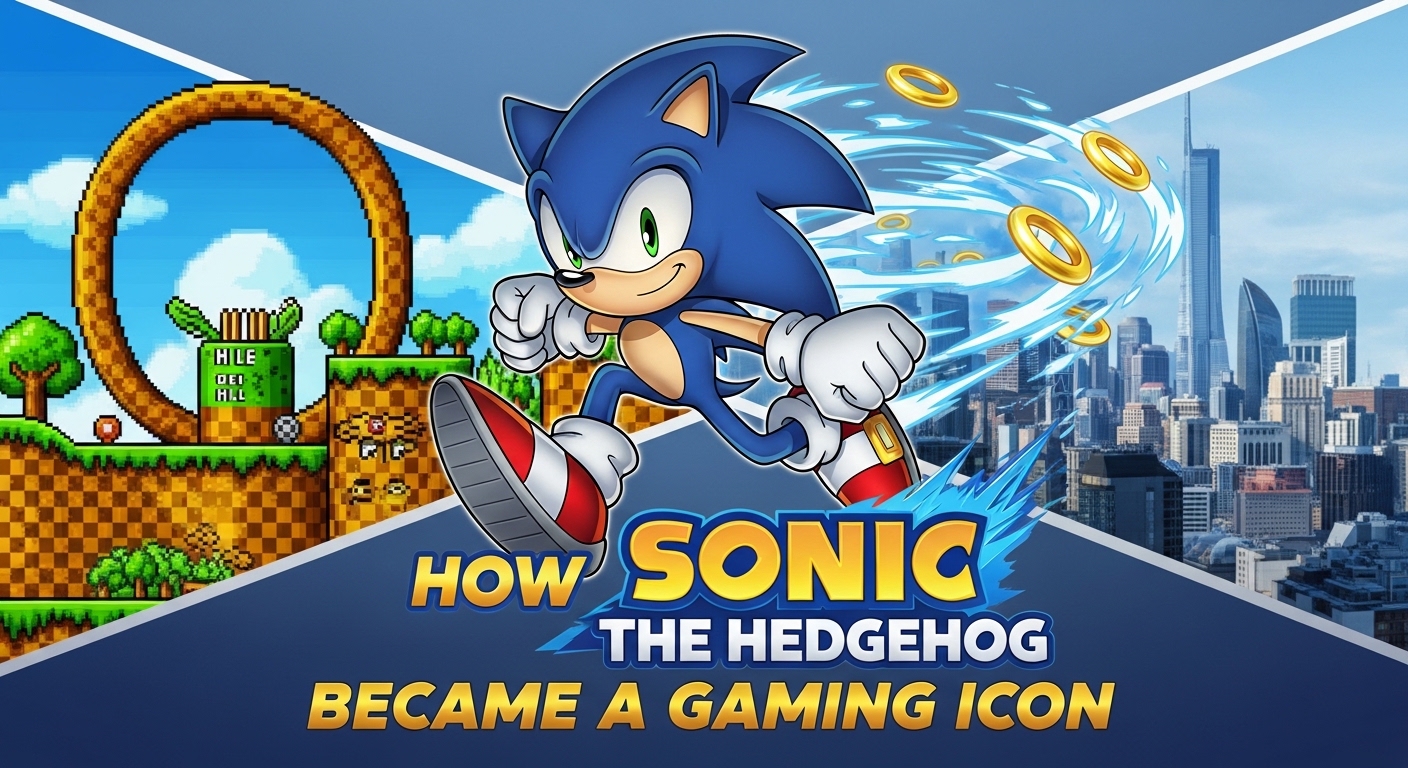
In the pantheon of video game characters, few are as instantly recognizable as Sonic the Hedgehog. With his electric blue quills, red sneakers, and an attitude that screams ’90s cool, Sonic was more than just a mascot; he was a declaration of war. Created to break the stranglehold of plumbers and princesses, Sonic didn’t walk—he ran. He ran at supersonic speeds, through loop-de-loops and across checkered landscapes, embodying a philosophy of “gotta go fast” that would define a generation of gaming.
But Sonic’s journey from corporate weapon to cultural icon has been anything but a straight line. It is a story of soaring highs, crushing lows, and a resilience that proves speed alone isn’t enough to stay relevant—you need heart.
The Birth of a Rival
The year was 1990. Nintendo’s Super Mario Bros. had dominated the home console market for half a decade. Sega, a scrappy arcade giant trying to break into the living room, needed a killer app for their new 16-bit console, the Mega Drive (known as the Genesis in North America). The directive to Sega’s internal development team, led by Yuji Naka, Naoto Ohshima, and Hirokazu Yasuhara, was simple: create a character that could beat Mario.
Their answer was a turquoise hedgehog (later changed to the now-famous cobalt blue to match Sega’s logo) who could roll into a ball and move faster than anything seen in a platformer before. The concept was a masterclass in showcasing hardware. While the NES struggled with scrolling speeds, the Genesis’s powerful Motorola 68000 processor allowed for “blast processing”—a marketing term that effectively promised seamless, high-velocity gameplay.
Released in 1991, Sonic the Hedgehog was an instant phenomenon. It wasn’t just the speed; it was the attitude. Sonic was a rebel. He didn’t rescue princesses; he fought for the freedom of his animal friends against the rotund, mustachioed villain, Dr. Ivo “Eggman” Robotnik. The game’s vibrant graphics, catchy music by Masato Nakamura, and innovative level design created a sensory overload that felt distinctly modern.
Sonic became Sega’s mascot, and the “Console Wars” of the early ’90s began. Sega’s edgy marketing— “Genesis does what Nintendon’t”—painted Sonic as the cool, fast alternative to Mario’s safe, family-friendly image. For a few years, it worked. Sonic the Hedgehog 2 (1992), which introduced Miles “Tails” Prower, and Sonic & Knuckles (1994) with its lock-on technology, solidified the franchise’s golden age.
The Blue Blur Expands
Sonic’s success didn’t stay confined to the Sega Genesis. He became a multimedia star. The Adventures of Sonic the Hedgehog and Sonic SatAM cartoons offered contrasting takes on the character—one a zany slapstick comedy, the other a darker, serialized story about resisting Robotnik’s dystopian rule. For many fans, the SatAM series provided a depth of world-building that the games only hinted at.
The character’s mythology grew richer with the introduction of fan-favorite characters like Knuckles the Echidna, the guardian of the Master Emerald, and the tragic anti-hero Shadow the Hedgehog. The franchise expanded into comic books, most notably the long-running Archie series and later IDW’s critically acclaimed run, which explored complex character arcs and lore in ways the games often couldn’t.
The Struggle for the Third Dimension
The turning point came with the shift to 3D gaming. Sega’s decision to discontinue the Sega Saturn in favor of the Dreamcast was a turbulent transition. The first fully 3D outing, Sonic Adventure (1998), was ambitious. It introduced an overworld, multiple character campaigns, and a cinematic story. While beloved by fans for its soundtrack and scope, it also revealed the inherent design problem that would plague the franchise for years: how do you translate Sonic’s core philosophy of speed into a 3D space without it feeling like an automated rollercoaster?
Later games would struggle with this balance. Sonic Heroes (2003) attempted to refine the formula, but the mid-to-late 2000s became a difficult period for the franchise. Sonic the Hedgehog (2006)—often referred to as Sonic ’06—was a critical and commercial disaster, plagued by bugs, loading screens, and a convoluted story that nearly killed the franchise’s reputation. The “uncanny valley” of realistic human characters alongside Sonic, and the game’s rushed development, became a cautionary tale in the industry.
Sega experimented with various solutions to salvage the Blue Blur. Sonic Unleashed (2008) introduced the controversial “Werehog” brawling sections. Sonic Colors (2010) wisely ditched the complicated narratives for a focus on imaginative, fast-paced platforming in a space amusement park. Sonic Generations (2011) served as a love letter to the franchise, celebrating its history by letting players switch between classic 2D and modern 3D gameplay styles. These games signaled a slow but steady recovery.
The Renaissance
After a decade of inconsistency, Sonic has experienced a remarkable renaissance in recent years. The release of Sonic Mania (2017) was a watershed moment. Developed by fans-turned-developers at Headcannon and PagodaWest Games, Mania was a pixel-perfect homage to the 16-bit era. It proved that the classic 2D formula wasn’t just nostalgia—it was timeless.
Simultaneously, Sonic Forces (2017) attempted to modernize the 3D formula but received mixed reviews. However, the true turning point for modern Sonic came with Sonic Frontiers (2022). Breaking from the linear level structure that had defined the series since Adventure, Frontiers dropped Sonic into “Open Zones”—vast, mysterious islands filled with puzzles, combat, and platforming challenges. While it had its technical rough edges, Frontiers was lauded for successfully translating the feeling of freedom and speed into an open-world context, earning some of the franchise’s highest critical scores in two decades.
This game resurgence has been bolstered by a successful film franchise. The Sonic the Hedgehog movies (2020 and 2022), starring Ben Schwartz as the voice of Sonic and Jim Carrey as a delightfully manic Dr. Robotnik, were a massive box office success. Notably, after an initial negative reaction to the first film’s character design, Paramount Pictures listened to fans and redesigned Sonic entirely—a rare moment of fan feedback directly shaping a major Hollywood production. The films introduced Sonic to a new generation, capturing his humor and heart without the baggage of the games’ inconsistent history.
Why Sonic Endures
So, why does Sonic continue to thrive? It isn’t just nostalgia. The character’s endurance is built on a foundation of optimism and a unique aesthetic. Sonic represents freedom. Unlike the methodical, exploratory gameplay of his rival Mario, Sonic is about momentum, rebellion against tyranny (embodied by Eggman), and the simple joy of movement.
His world, a fusion of surreal fantasy and retro-futuristic technology, is visually unique. The music, a core pillar of the franchise, has consistently featured high-energy rock, pop, and electronic scores that give each game a distinct identity.
Moreover, Sonic’s community is fiercely loyal. Fans have kept the spirit of the classic games alive through fangames and mods for decades. This passionate base, coupled with Sega’s recent willingness to embrace both its classic roots (Mania) and bold new ideas (Frontiers), suggests that the Blue Blur is far from slowing down.
As he approaches his 35th anniversary, Sonic the Hedgehog stands as one of gaming’s most enduring icons. He is a character who has weathered corporate wars, disastrous transitions, and a near-fatal dip in quality to emerge, once again, as a symbol of speed, style, and resilience. Gotta go fast isn’t just a motto; it’s the story of a character who, against all odds, managed to keep running.